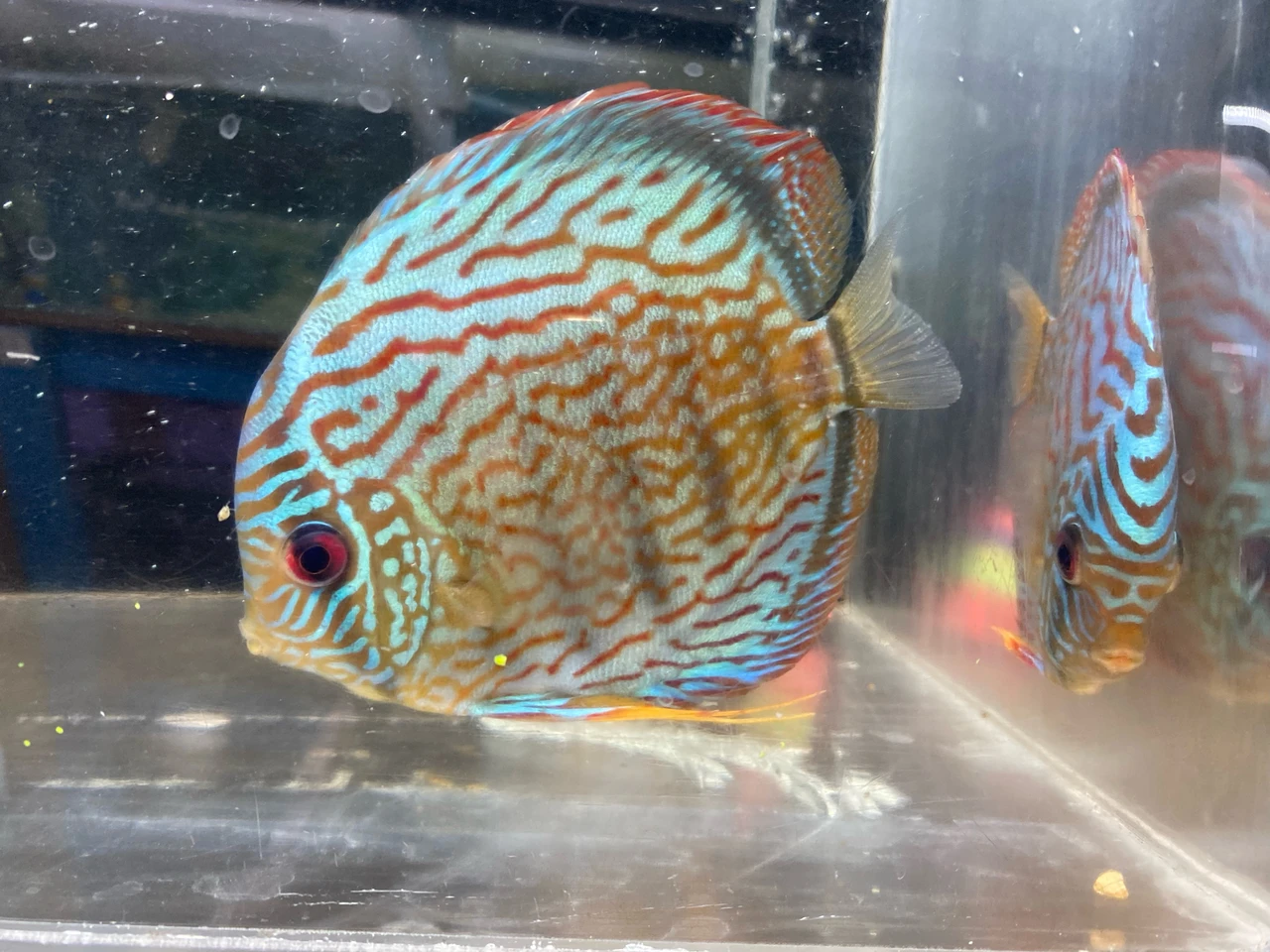
Red Turquoise Discus
- Size: 6–8 inches (15–20 cm) as adults
- Tank: 55 gallons minimum for a group, tall (20"+ height)
- pH: 6.0–7.4 (farm-raised stock is flexible; breeding favors 6.0–6.8)
- Temperature: 82–86°F (28–30°C) — notably warmer than most community fish
- Hardness: Soft to moderate (2–10 dGH)
- Temperament: Peaceful, shoaling — needs conspecifics to feel secure
- Difficulty: Intermediate to advanced (water quality demands, not fragility)
Overview
Red Turquoise is the strain that made discus a mainstream fish. It's a farm-developed color form — not a wild population — bred up over decades from the Symphysodon aequifasciatus/haraldi wild-type complex, selecting hard for the turquoise iridescence and layering red striping on top of it. The result is a discus with genuinely photographic color: an electric blue-green base crossed by irregular red streaks that intensify with age, good diet, and settled water.
It's also, not coincidentally, the strain most large-scale farms in Southeast Asia produce in the highest volume, which means Red Turquoise is usually the most affordable, most consistently available, and most beginner-tolerant discus you can buy. That reputation is deserved relative to other discus — it is not a beginner cichlid in the way a bristlenose pleco is a beginner catfish. It is the on-ramp to a genuinely demanding hobby, not an escape from one.
Discus in general are laterally compressed, disc-shaped cichlids native to slow, structurally complex stretches of the Amazon basin — flooded forest, submerged wood, leaf litter. That deep-bodied shape and shoaling instinct drive almost every care decision below: tall tanks, tankmates that won't nip fins, and enough conspecifics that no single fish becomes the target.
Tank Setup
Tank Size & Footprint
Minimum: 55 gallons for a small group of four to six juveniles growing out, with an eye toward upgrading as they mature. Adult Red Turquoise reaching 6–8 inches in a group of six genuinely want 75–125 gallons of long-term space. Height matters as much as footprint here — discus are tall-bodied fish, and a tank under 20 inches tall visibly cramps them. This is the opposite priority from most cichlids, where floor space rules; with discus, buy the tall tank.
Discus are also a shoaling fish, not a pair-and-done fish outside of active breeding. A lone discus, or a mismatched pair without a buffer group, tends to sit in a corner, dark and stressed. Six is a workable minimum group size for a display tank; more is better up to what your gallons can support.
Substrate: The Real Debate
Serious discus breeders overwhelmingly run bare-bottom tanks — literally no substrate, sometimes not even a background — because it makes daily siphoning of waste and uneaten food trivial, and waste control is the single biggest lever on discus health. If your priority is breeding, growing out juveniles, or quarantine/hospital use, bare-bottom is the practical choice, full stop.
For a display tank, a heavily planted or hardscaped Amazon-biotope setup with sand or fine gravel is entirely workable and arguably more true to how discus actually live — provided you're disciplined about gravel-vac maintenance and don't let organic waste accumulate in the substrate. This is a real trade-off, not a right-and-wrong argument: bare-bottom optimizes for water quality and ease of maintenance, planted optimizes for display and behavioral naturalism. Pick based on which one you'll actually maintain.
Hardscape & Cover
Driftwood, broad leaves (Amazon sword, large Anubias), and open swimming lanes suit the fish's natural habitat and give shy or subordinate individuals somewhere to retreat without disappearing entirely — you still want to see them. Avoid anything sharp-edged; discus have a delicate, easily-scraped body and mucus coat.
Breeding cones or vertical slate: If there's any chance of pairing off, include at least one broad, smooth, near-vertical surface — a purpose-made breeding cone, a piece of slate on edge, or a large leaf will all work. Discus lay eggs on vertical surfaces, not in caves, which is a meaningful behavioral difference from most other popular cichlids.
Water Chemistry
| Parameter | Range | Optimal |
|---|---|---|
| pH | 6.0–7.4 | 6.2–6.8 |
| Temperature | 82–86°F | 84–86°F |
| Hardness (dGH) | 2–10 | 3–6 |
| Ammonia / Nitrite | 0 ppm, always | 0 ppm, always |
| Nitrate | <20 ppm | <10 ppm |
Temperature is the number that surprises new keepers most. 82–86°F is well above the range most tropical community fish tolerate long-term, which is one reason discus get their own species tank rather than joining a general community. A quality heater with a reliable thermostat is not optional equipment here.
Modern farm-raised discus are more chemistry-flexible than their reputation suggests. Decades of captive breeding, especially from Asian farms supplying neutral-to-hard tap water, have produced lines that do fine at pH 7.0–7.4 without RO water. That said, breeding success and long-term vibrancy both improve in softer, slightly acidic water closer to the species' native Amazon blackwater and whitewater tributaries.
Filtration & Flow
Discus prefer gentle to moderate flow — strong current stresses a fish shaped like a dinner plate. Canister filters or sponge filters both work well; the filter capacity matters more than the flow rate, because filtration here is really about keeping ahead of a heavily-fed, warm-water tank's bioload.
Water changes are the actual filter. This is the single most repeated piece of advice in the discus hobby for a reason: serious keepers change 25–50% of tank volume every one to two days, especially with juveniles or breeding pairs. This is a materially heavier maintenance commitment than almost any other freshwater fish, and it is non-negotiable — skipping water changes is the single most common cause of stalled growth, hole-in-the-head disease, and stunted, dark, unhappy discus.
Feeding
Discus are opportunistic omnivores with a strong lean toward protein, and they're notably food-motivated once settled — feeding time is genuinely one of the more interactive parts of keeping them.
Daily Diet
- Discus-specific pellets (staple): High-protein formulas made for the species are the modern backbone of most keepers' feeding, and a well-chosen pellet line alone will grow and color up healthy fish.
- Beef heart mix (traditional, still widely used): A homemade blend of lean beef heart, vegetable matter, vitamins, and binder, frozen into flat sheets. Extremely effective for growth and color but demanding to prepare correctly and easy to overfeed or foul water with if you're sloppy.
- Frozen foods: Bloodworms, blackworms, and mysis shrimp are all readily taken and good for variety.
- Live foods: Blackworms and daphnia are popular live additions, especially for conditioning breeders.
Feed small portions two to three times daily rather than one large feeding — this matches natural foraging behavior and reduces the waste spike that comes with one big meal in warm water. Watch the group during feeding: a discus that consistently hangs back is worth investigating before it becomes a health problem.
Temperament & Compatibility
Red Turquoise, like all discus, is a genuinely peaceful fish toward other species — the aggression concerns here are almost entirely intraspecific, not interspecies.
Shoaling Behavior
Discus establish a loose pecking order within a group. Some flaring and chasing during feeding or as the hierarchy settles is normal; sustained, one-sided bullying of a single fish is not, and usually means the group is too small or a subordinate fish needs to be rehomed. A group of six or more dilutes aggression far better than a group of three or four, where it tends to concentrate on one individual.
Compatible Tank Mates
- Cardinal tetras: The classic Amazon-biotope pairing — shares water preferences, doesn't compete for food, visually striking against discus.
- Corydoras catfish: Peaceful bottom cleanup crew that tolerates warm water well.
- Rummynose tetras: Similar logic to cardinals — soft-water schooling fish that stays out of the way.
- Otocinclus: Algae control without competing for discus food or space.
Avoid
- Fin-nippers of any kind (barbs, some tetra species) — discus fins are a target and slow to recover
- Cichlids that compete aggressively for food or space
- Anything that can't handle sustained 82–86°F water long-term
Breeding
Pair Formation
Discus are monogamous pair-bonders, but pairs usually form on their own out of a larger group rather than being hand-picked — buying six to eight juveniles and growing them out together is the standard, reliable path to a compatible pair, since discus are notoriously difficult to force-pair as unrelated adults.
Conditioning
Once a pair has formed, condition heavily on high-quality food — beef heart mix, live blackworms, and frozen bloodworms in rotation — while stepping up water change frequency. A pair that's ready will often claim and clean a vertical surface together in the days before spawning.
Spawning
Unlike cave-spawning cichlids, discus lay eggs directly onto a cleaned vertical surface — a cone, slate, or broad leaf — in neat rows, typically 200–400 eggs per spawn. Both parents take turns fanning and guarding the clutch, and both remain involved through the entire fry-rearing process, which is unusual even among cichlids.
Fry Care — The Distinctive Part
This is where discus diverge from almost every other aquarium fish. Eggs hatch in roughly 48–60 hours; wrigglers stay attached to the spawning surface for another two to three days living off their yolk sac. Once free-swimming, fry don't go looking for infusoria or microworms first — they attach to their parents' flanks and feed on a nutrient-rich mucus secretion the adults produce specifically for this purpose. Parents take turns carrying the fry, and you'll see the brood transfer from one adult to the other over the following one to two weeks.
Do not remove the fry from the parents during this stage — separating them before they're feeding independently (typically 10–14 days post-hatch) starves them of the one food source they're built to rely on. After that window, fry gradually transition to finely crushed flake, newly hatched brine shrimp, and eventually crushed pellets, and can be moved to a grow-out tank if needed.
A note on artificial rearing: Commercial breeders sometimes pull eggs to hatch and raise fry entirely without parents, using specialized rearing techniques, precisely because the parental slime-feeding stage is hard to guarantee at scale. For a hobbyist with one pair, letting the parents raise the brood is both easier and more reliable.
Variants & Bloodline Differences
"Red Turquoise" isn't one fixed genetic line — it's a color-pattern standard that different farms and breeders hit in somewhat different ways:
Asian Farm Lines (Malaysia, Thailand, Singapore)
The dominant commercial source. Generally the most affordable, most consistently available, and bred for tolerance of a wider range of water conditions — a practical advantage for hobbyists without RO setups. Body depth and finnage tend to be slightly less extreme than premium lines.
German & European Lines
Typically pricier, more selectively bred toward specific body-depth and color standards, and more likely to be the source of genuinely new strain developments. Often require more careful water management to hit their full potential.
Why Lineage Matters
Two fish sold under the identical strain name can differ meaningfully in hardiness, adult size, and how forgiving they are of imperfect water. If a source can tell you the farm or lineage behind their stock, that's a genuinely useful signal — vague "discus, assorted" tags at a big-box store usually mean you're buying blind.
Common Issues
Hole-in-the-Head Disease (HITH)
Cause: Chronic poor water quality and/or nutritional deficiency, frequently linked to Hexamita and related flagellate protozoa taking hold once a fish is already stressed.
Fix: This is fundamentally a water-quality and diet disease, not primarily a parasite you medicate away. Increase water change frequency immediately, review diet variety, and treat with an appropriate anti-protozoal medication alongside — not instead of — fixing the underlying husbandry.
Stunting
Cause: Overcrowded juvenile grow-out, infrequent water changes, or inconsistent feeding during the critical early growth period.
Fix: Stunting is largely irreversible once it's set in. Prevention — generous water changes and adequate space from the juvenile stage onward — is the only real fix.
Dark, Stressed Coloring
Cause: Usually a symptom, not a disease itself — new water, insufficient group size, aggressive tankmates, or a chemistry swing.
Fix: Test water immediately. Check the group dynamic for one fish being singled out. Color should return within days once the stressor is identified and resolved.
Bloat / "Discus Plague"
Cause: A catch-all term hobbyists use for systemic bacterial or internal parasitic illness, usually following a period of poor water quality or an unquarantined new addition.
Fix: Isolate affected fish immediately, raise temperature toward the upper end of the range to boost immune response, and treat per veterinary or experienced-breeder guidance. Quarantine every new fish for a minimum of two to four weeks before it ever sees your main tank — this single habit prevents most disease introductions.
Where to Get Quality Fish
Discus quality varies enormously between sources, more so than most freshwater fish.
- Specialty aquarium stores: Pet Zone SD stocks quality discus when available, sourced and properly acclimated rather than rushed straight to the sales floor.
- Dedicated discus breeders: The best source for known lineage, guaranteed water-quality tolerance, and honest answers about a specific line's quirks.
- Avoid: Big-box stores with unlabeled "assorted discus" tanks, visibly pinched or stunted stock, and any seller who can't tell you feeding or water history.
Cost: Quality juvenile Red Turquoise typically run $20–40 each; larger, more mature, better-colored specimens climb well beyond that. Cheap discus from an unreliable source is one of the more expensive mistakes in the hobby once you count the water changes and medication it takes to nurse a bad batch back to health — if they recover at all.
Final Thoughts
Red Turquoise discus reward exactly the kind of unglamorous consistency most flashy fish don't ask for: steady heat, frequent water changes, and a real commitment to water testing. In exchange, you get a fish that shoals, pair-bonds, feeds its own young off its skin, and grows into one of the most genuinely striking centerpieces in the freshwater hobby.
Start with a group of six juveniles, a tall 55-gallon-plus tank, a reliable heater, and a maintenance routine you can actually sustain. Watch them settle, establish hierarchy, and color up over the following months. If a pair forms and spawns, you'll get to watch one of the most unusual parenting behaviors in the aquarium hobby play out in your own living room.
- Read care fundamentals for a deeper water chemistry and maintenance breakdown
- Jump to breeding guides for more on pairing and fry rearing
- Explore other strains once you've got a handle on Red Turquoise
Red Turquoise FAQ
How much does a Red Turquoise discus cost?
Quality juvenile Red Turquoise typically run $20–40 each, with larger, more mature, better-colored specimens climbing well beyond that. Cheap discus from an unreliable source often costs more in the long run once you count the water changes and medication it takes to nurse a bad batch back to health.
Is Red Turquoise a good beginner discus?
It's the most beginner-tolerant strain in the hobby and the usual starting point, thanks to farm lines bred for wider water-chemistry tolerance and high availability. That said, it's still not a beginner cichlid the way a bristlenose pleco is a beginner catfish — it's the on-ramp to a demanding hobby, not an escape from one.
How can you tell Red Turquoise discus apart by quality?
Look at body depth, finnage, and how evenly the turquoise and red striping covers the fish. Asian farm lines are typically more affordable and water-flexible with slightly less extreme body depth; German and European lines run pricier and are more selectively bred toward specific body-depth and color standards.
What size tank does a Red Turquoise discus need?
55 gallons minimum for a small group of four to six juveniles growing out, moving toward 75–125 gallons as they mature to 6–8 inches. Height matters as much as footprint — aim for a tank 20 inches or taller.